
Poisons
Objects described as ‘poisonous’ can be expected in a collection like MAA that contains weapons, plant specimens and medicines from around the world. However, some of these poisons may have long ago stopped being a risk to humans. Others, like aconite or abrus berries, remain an acute and high risk hazard. In yet other cases, an object may be labelled as poisonous as a result of poor documentation or inaccurate collection records. Nevertheless, some of these poisons are potentially the most hazardous objects in the collection at MAA.
Identification
Like pesticides and industrial poisons, identifying biological toxins is easier when you know what you are looking for. Though there are spot tests for specific alkaloids (e.g. Dragendorff or Mayer tests), these can confirm only a part of an object’s potentially poisonous nature. It is sometimes possible to confirm the presence of chemical toxins through sampling and mass spectrometry, but this can be an expensive and complex process.

A confirmed specimen of aconite, or monk’s hood (1926.429), likely from east Asia. Aconite is an acute and deadly toxin and should NOT be handled except when absolutely necessary and ONLY with PPE. Contact a conservator or poison control officer for guidance.

Bright red Abrus precatorius seeds have been used in many cultures of the Pacific, Asia and Africa as beads and decorative elements in objects of personal adornment such as this one from Nagaland (1919.103.18). This object should be handled with gloves and if any of the beads become damaged, contact a conservator or poison control officer immediately.

Historic medical collections can contain some of the more volatile substances at MAA, such as a 19th century British medical kit with empty containers for both strychnine and opium. MAA 1979.651.10Glass jar for storing Dover Powder, Central Africa. Collector: Rev. Andrew Simpson.
Safe Handling and Response
In all cases, the best way to assess risk from materials suspected as poisonous is to consider what the object or specimen was used for and where it is from: For example, did the cultural group of origin have access to marine toxins or venomous reptiles? Is it a medicine known for general well-being or one which would provoke sleepiness, numbness or induce a violent physical response? What kind of plants grew in the landscape of origin? Is it an object for daily use with which one might frequently be in contact, or one which is meant to demonstrate high status or value on special occasions? This information can help you make informed decisions about the potentially poisonous nature of the materials.
Note: Many weapons in the collection – including spears, arrows and other blades – have been coated with beeswax, which can darken and become grimy over time. Beeswax is easy to distinguish under a UV torch (365nm) where it appears yellow or yellowish-green. This wax is not only harmless to humans and most metal objects, it can easily be removed by a conservator.
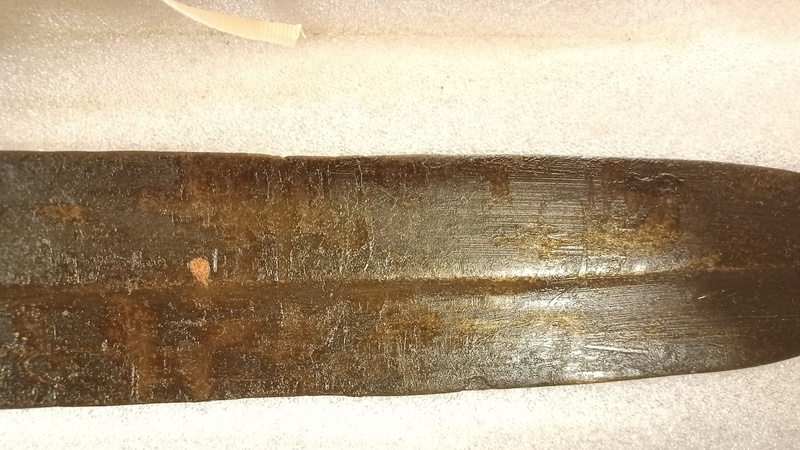
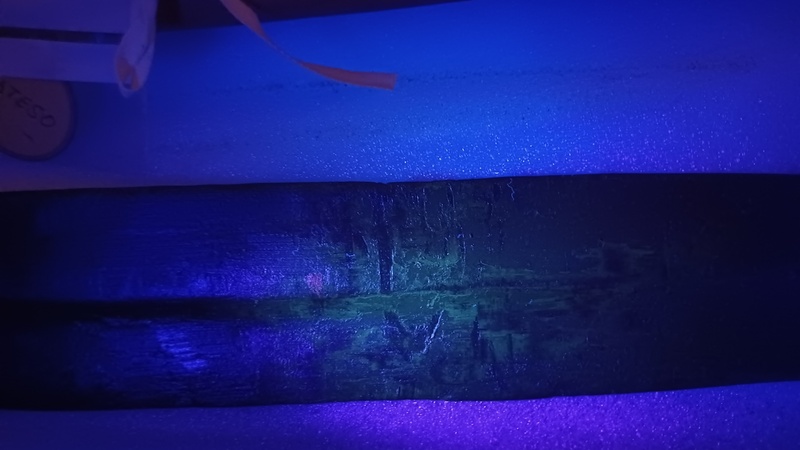
A bladed weapon with a dark brown, greasy coating can be confirmed as beeswax with the use of a UV torch, under which it should appear yellowish. Several of these greasy deposits on metal weapons from various cultural groups have been sampled and confirmed as beeswax during the Stores Move project. It was likely applied to protect the blade during long-term storage.
Because it can be difficult to confirm the presence or volatility of poisonous substances without informed chemical testing, materials which are identified or suspected as ‘Poisons’ should also be labelled as ‘Hazards’ in the ‘Special collections and Hazards’ section of the object record in the collections management system and with red ‘HAZARD’ triangles. They should be photographed to promote visual or digital access, handled minimally, and packed to prevent contact with the skin or eyes. Objects which are suspected as poisonous and in stable condition can be handled with disposable gloves; eye protection, protective clothing (e.g. lab coat) and a mask can also be used if the materials are dusty or powdery. Objects which are suspected as poisonous and in poor condition should be flagged for conservation and isolated – i.e. sealed in polythene sheeting and labelled as hazardous – immediately.
Note: Botanical specimens and medicines like coca leaves, opium and cannabis – as well as the objects used to store or activate them – as well as the objects used to previously store or activate them – should be labelled as ‘Controlled Drugs’ in the ‘Special collections and Hazards’ section of the object record. MAA has a legal obligation to restrict access to these materials; curators or collections managers should advise on storage and compliance.
Further Resources
Borgia, V et al., ‘Poison, plants and Paleolithic hunters. An analytical method to investigate the presence of plant poisons on archaeological artefacts', 2017.
Museum of London, ‘Hazards in collections - Controlled Drugs’, 2019.
Pitschmann, V and Hon, Z., 'Military importance of natural toxins and their analogs', 2016.