
Pesticides
Historic pesticide use is common in museums and other collections with large amounts of organic material like skin, feathers, textiles or plant fibres. Some of these pesticides pre-date the arrival of objects at the institution; others may have been re-applied by previous custodians or collectors. There is very little historic documentation on pesticide use at MAA and laws in the UK governing these chemicals have changed multiple times in the lifetime of the museum, along with standards for best practice. And yet – with appropriate PPE, clear labelling, and well-informed risk management – these collections can still be made safely accessible for research, handling, transport and outreach.
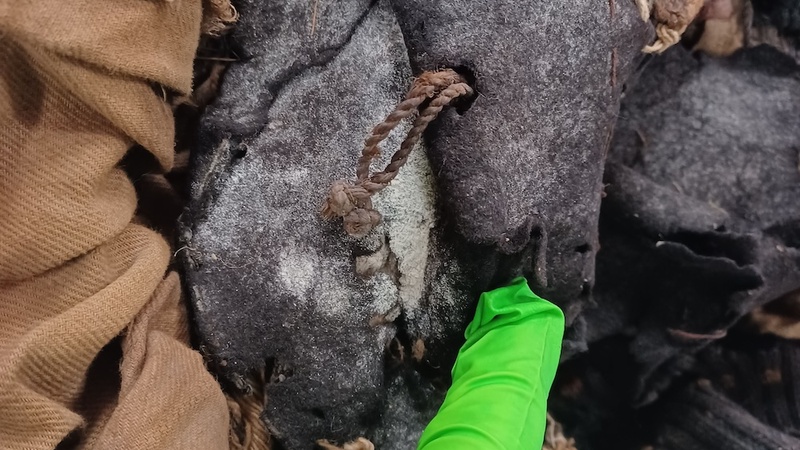
Suspected pesticides and pesticide residues can take many forms, from opaque white powders to fine crystals on a surface. They may have a smell or be odourless. This image shows a white powder with a strong smell on a mask made with wood, textile, and animal bones (Z 13785).
Identification
Suspected evidence for pesticide use in the collection at MAA includes various white or light-coloured opaque powders as well as a fine white or clear crystalline residue. A few objects were also noted to exhibit a strong chemical smell. Observations of pesticide use are almost entirely restricted to Anthropology collections and very few of these interventions are recorded in the museum archive or other documentation.
At present, confirming the identity of suspected pesticides requires multiple forms of scientific analysis: While some heavy metal salts like arsenic or lead can be confirmed with micro-chemical tests (e.g. Plumbtesmo strips), others like organic pesticides developed for agricultural food production in the 20th century (e.g. DDT, lindane) might require more advanced instrumentation like mass spectrometry or x-ray fluorescence (XRF) spectroscopy. It is not possible to say – based on condition or appearance alone – whether an object has had a pesticide applied to it, or whether that pesticide continues to pose a risk to humans.
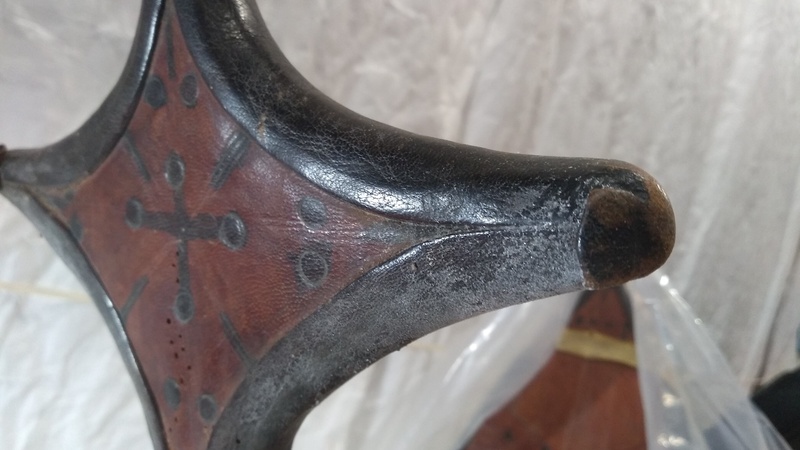 During the Stores Move project, a fine, clear crystalline residue was seen on many leather objects, including this saddle from east Africa (D 1937.241). These residues can become loose and should always be handled with disposable gloves and a full face protection (FFP) mask. They can be reduced – but not necessarily removed – by a conservator using a vacuum with a high-efficiency particulate air filter (HEPA).
Furthermore, some objects may have been treated with pesticides more than once in their lifetime. In all cases, it is very helpful to have an idea of what kind of pesticide you are looking for in order to identify it: Organic pesticides like ethylene oxide or naphthalene require different forms of analysis than those with halogens attached (e.g. methyl bromide, paradichlorobenzene, Vikane [sulphuryl floride]) or heavy metal salts of arsenic and mercury.
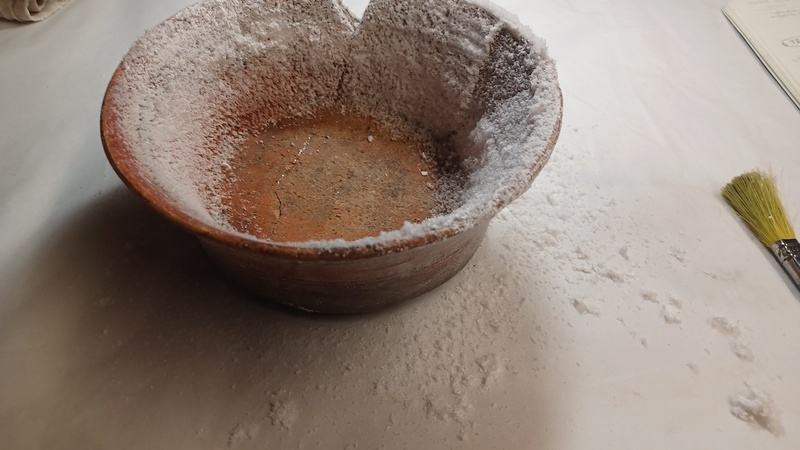 This ceramic vessel (1963.259) has a salt problem resulting from inappropriate storage conditions and/or acidic packing materials. It can be distinguished from mould because it is will reflect and transmit light (i.e. ‘glitter’). Because it is an inorganic material — therefore not vulnerable to pests like feathers, skin or wood – it is unlikely this would be a pesticide residue. Contact a conservator for further guidance.
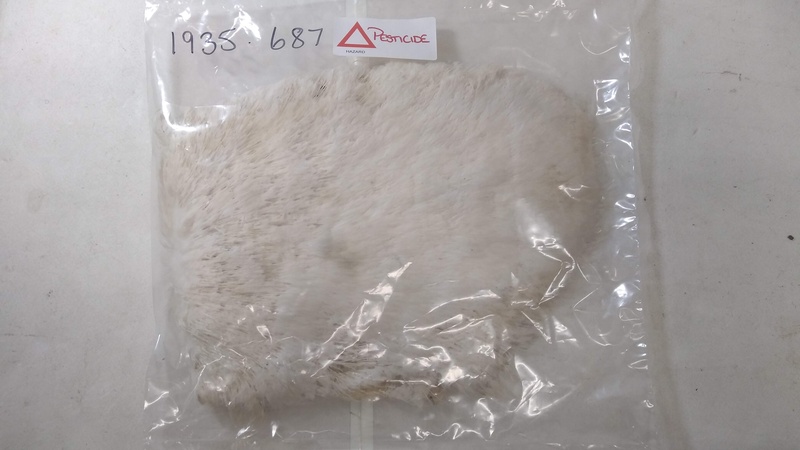
This object (1935.687) has been flagged for a ‘suspected pesticide residue’ and was noted to have a strong smell. It was not possible to reduce these hazards so the object was sealed in a labelled polythene envelope to facilitate long-term storage and safer access.
Note: Dry powdery mould can sometimes be mistaken for a pesticide residue. The easiest way to make this distinction is by using a torch, or other small light, and moving it back and forth at an angle above the surface of the object. If the surface sparkles or glitters, it is more likely to be a pesticide, since mould is usually matt and powdery. However, if the object is made from ceramic, shell, or glass, it is less likely to be a pesticide residue and might be a salt or other corrosion product.
Safe handling and response
At present, it is very difficult and expensive to decontaminate objects treated with historic pesticides and especially when the chemicals used have not be identified. However, loose residues and powders can be reduced using a dry brush and a vacuum with a high efficiency particulate air filter (HEPA); ask a conservator and/or the University Health and Safety Office for further guidance. It is also important to make a note of any new or undocumented evidence for pesticide use, including links to archival information, photography and a short description in the digital object record on the collections management system.
In general, pesticides which have been applied as powders or which have formed deposits on surfaces are the most challenging to manage. For these, it is recommended that you use a FFP mask to prevent inhalation, and disposable gloves and protective clothing like a lab coat or apron to prevent skin contact or the transfer of residues beyond the collection space. After handling objects, do not eat or drink or use personal objects without washing your hands. Do not dispose of pesticide residues in the regular bin; ask a conservator and/or University Health and Safety Office for support. Anything suspected to be a risk for handling due to the presence of pesticide residues should be documented and sealed in polythene for accessible long-term storage and future pest management.
If you need to document a suspected pesticide residue in the object record, go to the ‘Special collections and Hazards’ section of the collections management system and select ‘Pesticides’. Add a short description of what you are seeing that makes you suspect pesticide use. If it has a loose residue, strong smell or needs special handling, select ‘Hazards’ at the top of the menu as well as ‘Pesticides’, and add a label to the storage materials.
Note: Unless you have done testing to confirm the identity of a pesticide, you should aim to describe what you see in the collection record as a ‘suspected pesticide residue’: What colour is it? Is it clear? Is it powdery and loose? Do you notice a smell? (Do not sniff.) Even a short description can help keep future users safe and direct further research.
Further Resources
Angelova, L., et al. ‘The use of 'poisonous insecticidal solutions' in bookbinding: coping with historic pesticide treatments in the archive’, 2023.
Carrlee, E. ‘What that white stuff? Caring for Alaskan artifacts’, 2011.
Charlton, A., et al. ‘Pesticide residues on the Cook-Voyage Collections at the Pitt Rivers Museum, University of Oxford,’ 2015.
Chiwara, D., et al. ‘Potential pesticide contamination in repatriated artifacts in African museums: The need for the adoption of safety protocols for access and use of hazardous artifacts,’ 2022.
Odegaard, N. and Sadongei, A. Old Poisons, New Problems: A museum resource for managing contaminated cultural materials. Altamira Press, 2005.
UK Health and Safety Executive, ’UK Authorised Biocidal Products’, 2024.