
Documentation
Documentation plays an essential role in the safe preventive care and risk management of collections. It can include information about suspected or identified hazards and take the form of notes made in the object’s digital record, a red triangle ‘HAZARD’ adhesive label on the storage container, and guidance on the use of personal protective equipment (PPE). When accessing the collection – either digitally or in person – this information is put in place to make it easier to handle objects and have conversations about their care.
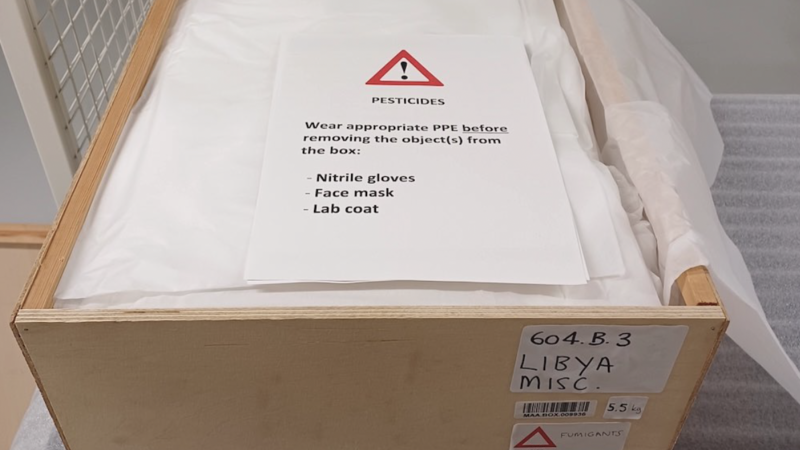
Hazard labels in storage on the outside of this container warn users in advance that the objects inside may have been treated with a pesticide. This information is also recorded in MAA’s collections management system. Printed guidance on the inside of the box suggests the use of disposable gloves and protective clothing to avoid transfer of harmful residues to your person or the environment, as well as a face mask to avoid any loose airborne residues during handling.
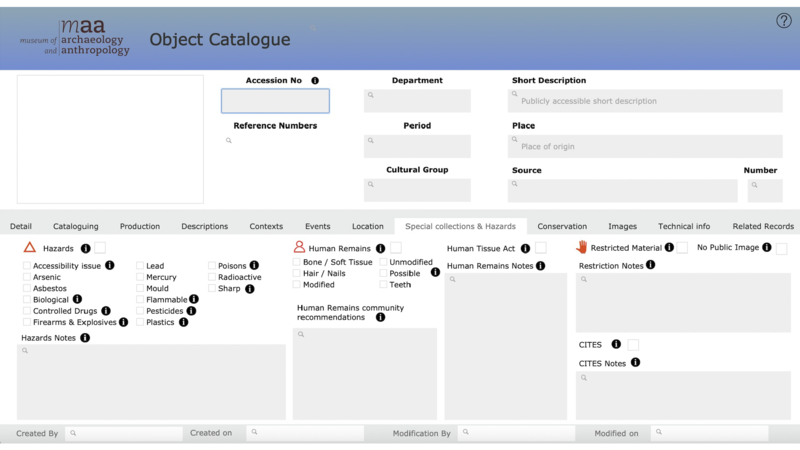
In the current version of the collections management system, known and suspected hazards are documented under the tab for “Special collections and Hazards”. Here it is possible to describe the material’s condition or appearance and to record information about how it can be safely stored and handed. These entries should be signed and dated.
Sadly, a museum’s documentation will not always reflect current UK safety standards or clearly describe historic museum practices. The following guidelines therefore include further resources for identification, testing, and control as well as suggestions on how to add to our collective knowledge of hazards at MAA.
Note: There is currently an option in this section of the collections management system to flag objects as made from or containing ‘Plastics’. Though some plastics can become hazardous as they deteriorate, they are not necessarily harmful to other objects or people if kept in a relatively stable and well-ventilated environment. The option to flag ‘Plastics’ in ‘Special collections and Hazards’ is meant to inform conservation monitoring and research on the long-term aging of plastics in museum storage more than to indicate a present risk. Cellulose nitrate and cellulose acetate are important exceptions since both of these become increasingly flammable as they deteriorate (see Flammable and Combustible Materials).