
Heavy metals
The hazardous character of heavy metals like arsenic, lead or mercury depends on their form: In stable condition, metallic lead, painted objects with pigments like cinnabar or orpiment, and alloys like pewter are relatively safe to handle with gloves whereas powdery or corroded heavy metals, flaking or powdery paint, or loose elemental mercury found in a thermometer, for example, are more mobile and therefore more difficult to control. Heavy metals are most dangerous through chronic exposure or when ingested but can also be irritating to skin and eyes, and breathing airborne particles should be avoided.
Identification
Due to the development of industrial safety standards for food, medicine and the environment, heavy metals are easily identified by XRF spectroscopy or micro-chemical tests like commercially-available Plumbtesmo strips; ask a conservator or occupational health and safety officer for guidance.
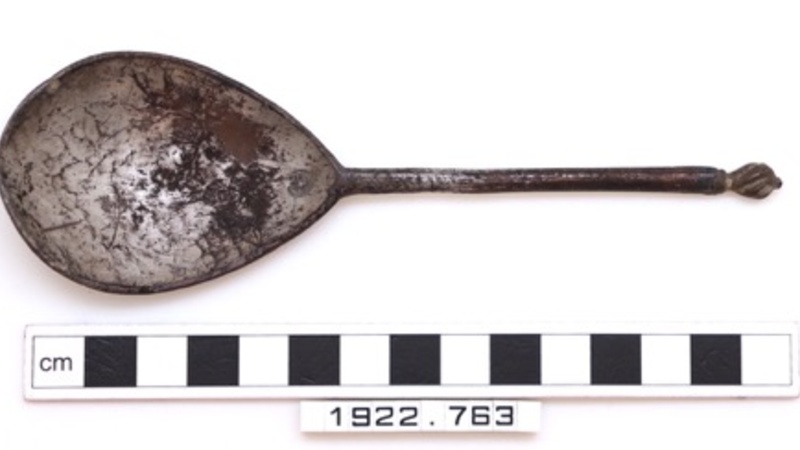
Metallic lead and its alloys – like this 15th century pewter spoon from the UK (1922.763)– are often notably heavy compared to other metal objects of similar size. However, if the metal is not powdery or corroded, it is generally safe to handle with disposable nitrile gloves.

This is one of many containers (1920.83.1-2) with heavy metal residues from the use of compounds of antimony or lead in cosmetics in many cultures. This particular example is from west Africa and is a relatively low risk to humans if kept closed or opened while wearing gloves and FFP mask.

Metallic lead is frequently found in Roman objects (Z 16592.1) and coins, and used in weights and measures. Only if it the lead is powdery should it be labeled as hazard. Lead which is stored within or around wooden or non-archival paper materials should be monitored for corrosion.

In the 17th and 18th centuries, mirrors – including the decorative elements added to this textile from south Asia (1978.107) – were often made by combining tin and mercury. This alloy can become unstable over time, resulting in the separation of liquid mercury. Objects with tin-mercury mirrors – noteworthy for their blueish tinge relative to other types of mirror when covered with a piece of white paper – should not be frozen due to the degradation of tin under -7 degrees C. They can be safely handled with gloves or clean hands washed with soap and water afterwards.

Photomicrograph of a deteriorated mirror showing metallic mercury forming between the characteristically round and white tin corrosion product (230x magnification).
Safe Handling and Response
In general, exposure to heavy metals is well-below safe limits working in a museum collection like MAA. It is important, however, to consider the condition of the object in assessing their risk: Stable materials or surfaces are generally safe to handle with disposable gloves alone. Only powdery, flaking, or other loose forms of heavy metal-containing materials should be designated as ‘Hazards’ in the collections management system or with a red ‘HAZARD’ triangle in storage. Where possible, further identifying them as ‘Arsenic’, ‘Lead’ or ‘Mercury’ is also useful. When designated as hazardous, heavy metals should be handled with disposable gloves as well as an FFP face mask. When in doubt, ask a conservator and/or the University Health and Safety Office.
Further Resources
Hadsund, P. ‘The tin-mercury mirror: Its manufacturing technique and deterioration processes’, 1993.
Slocum, N. ‘Toxins in the Collection: Museum Awareness and Protection’, 2018.