
Flammable and combustible materials
Flammable materials can be found throughout the collection at MAA but are especially problematic in photographic objects, film and early plastics. This is especially true of cellulose acetate and cellulose nitrate, which can both become unstable and self-igniting if not stored at a consistently low temperature (less than 15C). Gunpowder flasks, firearms, fireworks and historic lighting or cooking equipment can also be hazardous due to risk of combustion. Note that objects identified with creosote on the surface are not only potential inhalation hazards, they are also at increased risk of being flammable.
Identification
Unfortunately the only way to know if a material is flammable is to confirm its identity through documentary evidence or testing – or to observe it burning – which is why preventive care, labelling and the effective management of storage conditions are key to the safety of both people and collections.

An empty kerosene lamp (1982.863) in the collection at MAA. Kerosene will evaporate over time and like many other historic lamps, matches and inflammable objects, as long as it is kept away from high temperatures or a source of flame or ignition, it should be safe to store and handle.

One of several gunpowder flasks in the collection at MAA (1935.788). Most of these containers are empty and a low risk of combustion if stored in a stable environment with a relatively low temperature (<20 C). Note that in the UK, the storage of firearms and other potentially explosive materials is subject to a special license from a Police Firearms Liaison Officer.
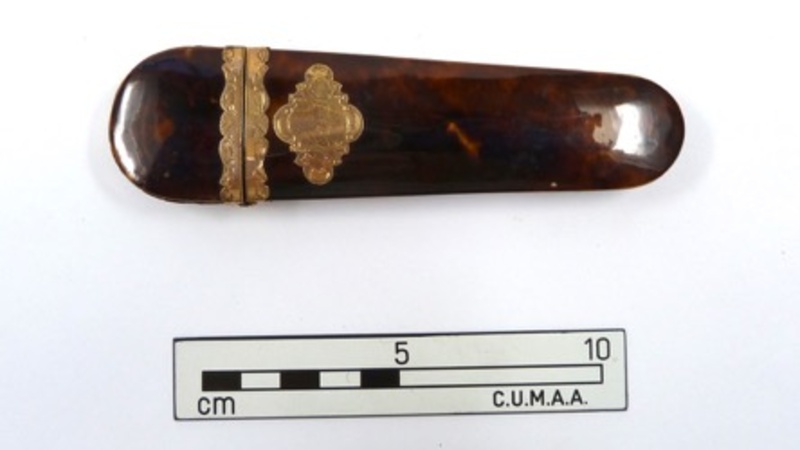
Cellulose acetate was not only used for film and photographic negatives, it was used as a tortoiseshell substitute for glasses and personal items like this one (1918.166) during the late 19th and early 20th centuries.
Safe Handling and Response
For gunpowder residues, fireworks and acetate films, smell is an important indication of the stability and safety of a flammable material: When stable, these materials should smell of acetone or alcohol, if anything. They should immediately be flagged as hazardous and moved to cold storage if they smell of vinegar (acetic acid). Films and other acetate should also be identified as ‘Plastics’ and considered hazardous if they are sticky, peeling or flaky.
In the ‘Special collections and Hazards’ section of the digital object record, select ‘Flammable’ for materials which are known to be flammable or combustible but only ‘Hazards’ if they are unstable or in poor condition.
Note: MAA is required by the 1968 Firearms Act to document, restrict access and store some firearms – including blowpipes and flintlocks – according to the discretion of a Police Firearms Liaison Officer. Objects identified as ‘Firearms and Explosives’ should be labelled with a red ‘HAZARD’ triangle with the note ‘F&E’ on their storage container and flagged in the ‘Special collections and Hazards’ section of the digital object record.
In packing for storage, it is good to remember that a fire needs three things to burn: fuel, heat and oxygen. Packing objects in plastic – rather than acid-free tissue – is one way to control access to fuel and/or oxygen. For materials which can become self-combusting such as acetate and nitrate films or gunpowder, these should be stored at low temperature (<20 C) to slow their deterioration and decrease risk of fire.
Further Resources
Collections Trust UK/Imperial War Museum, ‘Firearms and the law’, 2016.
Lim, X., ‘These cultural treasures are made of plastic. Now they’re falling apart,’ 2018.