
Sudan and South Sudan: Objects of power and contested power
What do a rain stone, a pepper horn and a 'poison antidote cup' have in common?
As visitors, we are beginning to ask more questions about how and why objects entered our museums. Labels and catalogue entries are often bare and descriptive, but we know that the objects nestled behind the glass cases and in storage boxes have more complex and often troubling histories.
One common thread, in researching these histories, is power.
Objects were often taken because they were thought to be powerful, perhaps associated with people of influence. In other cases, the act of taking an object conveyed power over a previous owner. Giving an object to a museum could be a way of constraining its otherwise unpredictable power. Once in museums, some objects have served to construct and reinforce heirarchies of power and difference in other ways.
This is one reason why objects in museums continue to stir intense and conflicting emotions. Such objects do not lose their power over us, even though they may be far removed from their original places and owners.
This trail explores some of these stories of power and contested power.
It is based on research carried out in MAA's archive and stores. It looks at a group of objects from Sudan and South Sudan.
These objects are all implicated in the making and breaking of power. Some were looted or removed under duress. Others were given as gifts or passed through multiple hands. But even these more negotiated exchanges can be disputed: a gift is not always given freely; a request can be impossible to refuse. In these cases, the workings of power can be more difficult to unravel as we attempt to retrace the routes of objects to the museum.
Explore the objects in this trail:
- A rain stone belonging to Leju Io Lugor
- An imported knife
- Helmet 'taken from the enemy' by General Charles Gordon
- Drum, 'captured' from an Otuho village
- Ramadan Ali Burrah's pepper horn
- A poison antidote cup
- A gift from the Divine King
- Queen Ikang's waist beads
- A spear made by Mohamed Toto Furauri
- 'Warriors' headdresses'
A rain stone belonging to Leju Io Lugor
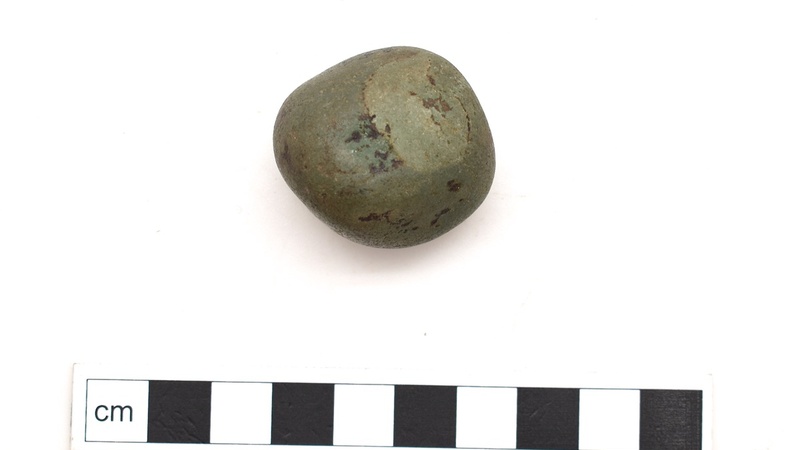
Before colonial administration (1898-1956), Bari people, who live in the area around Juba (the modern capital of South Sudan) were ruled by individuals who could control the weather. Authority was derived from the ability to bring rain. Rain stones were an important part of this craft. Rain makers conducted rituals involving these translucent, sacred stones to bring forth rain.
So important was rain – in the right place at the right time – that areas controlled by rain makers were called their ‘clouds’; and Bari people saw their community as divided by boundaries in the sky, as much as by those on land. But being a rain maker could be a dangerous occupation, drought could result in death, as people took justice into their own hands against those who were thought be withholding the rain.
Given the power of rain makers, it is hardly surprising that early colonial administrators and anthropologists were fascinated by these men and women. Understanding their position, role and influence was thought be essential to understanding (and exploiting) the workings of power in Bari society.
This helps us to understand how and why there is a rain stone in MAA’s collections. This stone was given to the museum by Ernest Balfour Haddon. He was the son of one of the museum’s curators and also a colonial administrator. He acquired the rain stone from one of the most powerful rain makers of the early twentieth century: a man called Leju lo Lugor who was in charge of a rain shrine at Shindiru, the largest of all shrines, said to contain over two hundred rain stones.
Although we do not know exactly how he obtained this stone from Leju, we know that Haddon visited Leju at Shindiru between 1909 and 1910, in the early years of British administration. Several years before, during a drought in 1904, Leju had sought refuge with a previous administrator. Perhaps he saw this gift to Haddon as a way of maintaining relationships with a potentially useful, but unpredictable, foreign power? Perhaps Haddon made a request and Leju felt obliged to fulfil it?
An imported knife

This knife belonged to a chief's deputy. It is one of several objects on the trail that gained power by its association with 'foreign' people. We will see that, in different ways, appropriating and domesticating foreign objects can be a way of reinforcing the power of the owner.
This knife was obtained by the famous English anthropologist Edward Evan Evans-Pritchard, during his field work in Yambio, in what is now South Sudan. Yambio was a centre of the expansive Zande Kingdom. The town was named after the famous prince 'Yambio' (also called 'Gbudwe') who was fatally injured in a British patrol in 1903.
Twenty years after Gbudwe's death, when Evans-Pritchard conducted his fieldwork, Zande people were under British colonial administration. But colonisation had not erased their historical institutions of power, which continued to exist, sometimes uneasily, alongside the colonial government. This knife would have belonged to someone from the ruling Avongara class - the leaders of the Zande Kingdom - who also held the position as chief's deputy in the colonial administration.
The workmanship on this knife is recorded as being by Mangbetu or Abarambo people. They were neighbouring communities, living in Congo and Central African Republic, with whom Zande people had long histories of exchange. Its position as an imported piece of art - indicative of far reaching relationships and influence - increased its value and status.
Helmet 'taken from the enemy' by General Charles Gordon
Some of the objects from Sudan and South Sudan in MAA's collection could be considered 'loot': they are objects taken in the context of war. Looting is an assertion of victory and power. It has been common practice in war for centuries. During the European colonisation of Africa, soldiers looted objects as a way of displaying their power over colonised people and to fund the costs of warfare.
This helmet - and a matching chain mail jacket - were donated to MAA by Lady Genevieve Watson in 1916. They had been a gift from General Charles Gordon to her late husband Sir Charles Watson.
General Gordon is one of the most famous figures of the Victorian era. His life, and death, were intimately connected to Empire and Sudan. He was killed in 1885, in the Siege of Khartoum, trying to defend the Egyptian government against the insurgent Mahdist army, who overthrew the Ottoman-Egyptian government and ruled Sudan until 1898.
Gordon was waiting for an unsuccessful rescue mission when he was killed. Sir Charles Watson was one of Gordon's closest friends and the acting Sirdar (Commander in chief of the British controlled Egyptian Army) in Cairo at the time.
It appears that before his death, Gordon had taken this helmet and chain mail off the body of a Sudanese soldier. He somehow managed to send it to Egypt, as a gift to Watson. After Charles Watson's death, his widow gave it to MAA in his memory.
This helmet is a complicated power object. It is a trophy of war, but also a relic of General Gordon.
Drum, 'captured' from an Otuho village
The status of objects as ‘loot’ are sometimes complicated in other ways. We know that some of the objects in the museum passed through different hands before being removed from Sudan. This drum was donated to MAA in 1928 by a man called Edward Grove. Grove was a military officer who worked as an administrator in the Government of Sudan between 1918 and 1919. He obtained this drum in a Ma’di village, near the border of what is now South Sudan and Uganda.
But this drum was not made by the villagers Grove met. They had previously taken it in a raid on a nearby Otuho village. It was actually made by a Otuho craftsperson. Two other musical instruments – horns – that Grove donated to MAA were also taken on this raid.
Grove confessed that he did not know what the drum was for, but had been drawn to it because it was very different from other drums he has seen in the village. For the Ma’di raiders, as for Grove, this was an unusual and foreign object. It drew power from its ‘foreignness’ and a history of appropriation.
Ramadan Ali Burrah's pepper horn
This pepper horn is an object touched by slavery, conflict and colonisation. Darfur was one of the last areas of Sudan to be brought under Anglo-Egyptian administration. It was ruled as an independent Sultanate until 1916. Ali Dinar was the last Sultan of Darfur.
Ramadan Ali Burrah died on the battlefield defending Darfur against the British invasion of 1916, which brought an end to Sultanic rule. Although a young man at the time, he was Commander in Chief of Sultan Ali Dinar’s army, one of the most important positions in the Sultanate. But Ramadan had not always held such high status. He was from a Binga community in south of Darfur, a region that was historically raided for slaves. He was himself enslaved as a child, then taken into Sultan Ali Dinar’s ranks by force. He fought beside Ali Dinar at the Battle of Omdurman in 1898, while he was likely still a child. When they returned to Darfur together, he rose through the ranks.
Twenty years after Ramadan’s death, his pepper horn was purchased by John Antony Arkell in Al Fashir, Darfur between 1932 and 1937. Arkell was assistant governor of Darfur at the time. Al Fashir, the headquarters of the British Administration had, until 1916 been the seat of the Sultanate of Darfur.
A poison antidote cup
Like Ramadan Ali Burrah’s pepper horn, this cup is connected to people and power that existed in Sudan before the British colonial administration.
Its history goes back to the nineteenth century, when Sudan was first being drawn into global imperial and commercial networks. Enslavement and extraction were part of these processes.
It was given to Cyril Crossland (the Director of the Sudan Pearl Fisheries, an institution on the Red Sea coast that produced pearl for the European market) by a man called Saleh Effendi Yusef. Saleh worked as a storekeeper at the Sudan Pearl Fisheries on the Red Sea Coast, but before the Reconqust of Sudan in 1898 and after the Mahdi’s rebellion, he had worked in the mint and arsenal of the Khalifa – the leader of the Mahdist state - in Omdurman. The cup, made from rhinoceros horn, had belonged to his father, who is not named in the museum records but is described as ‘a great slave dealer who flourished exceedingly under the Mahdi and Khalifa.’When Crossland gave this cup to MAA, he reported that it was believed that when milk was drunk from this cup, it was an antidote to poison.
The career and family history of the cup’s previous owner, Saleh Effendi Yusef, shows the different sorts a power an object can have: power of exchange, power of heredity and power of defence against poison.
A gift from the Divine King
Paul Philip Howell was given this throwing stick by Fafiti Wad Yor the Reth (Divine King) of the Collo or ‘Shilluk’ people in 1937 Kodok. Howell was a student at Trinity college at the time, and was visiting Kodok (the seat of Collo kings) as part of a study trip the college had funded.
The Reth evidently took some pity on Howell, as he did not have a stick (considered an essential accessory by Collo men). We might see this as a light hearted gift, or a more speculative approach to alliance building between the Reth’s kingdom and foreign powers. Howell was a student at the time and was accompanied by his uncle who was Assistant Commissioner. Howell went on to work in the colonial administration in Sudan. He became the District Commissioner of Upper Nile, so this turned out to be a well-judged offering.
Queen Ikang's waist beads
These beads were given to the anthropologist Brenda Seligman on 3rd February 1922, in exchange for salt and other beads. They were given to her by a woman called Ikang, who was a rain maker and a person of great power and influence. She lived in Tirangore in the south east of what is now South Sudan. She died in 1938, after a lifelong and close association with rain making. She was the daughter of two rain makers, she had been married to three rain makers. In 1922 she was considered, by foreign visitors, to be the most influential person in Tirangore. At this time, she was in control of the rain and was also elected to be the ‘government chief’ and deal with the equally uncertain and precarious force of the colonial state. Ikang, and her husband Ibrahim, gave Charles and Brenda Seligman information about Otuho society.
The association between these bead and Ikang is enough to give them a fascinating connection female power. But the story of these beads is even more intriguing. Ikang told Brenda Seligman that they had been taken (presumably by force) by a party of Otuho people who accompanied Emin Pasha to Bor. The Bor Dinka valued them so much they were considered almost priceless, and today these distinctive blue beads, known usually as ‘Guet Jang’ are still highly valued and are only worn by men who have completed a traditional marriage.
We could see Ikang’s possession of these beads as a symbol of her mastery of different forms of power – over gender relations, social order, rain and the government. They were kept in Tirangore for fifty years after they had been taken from Bor. This complex history raises many questions about her decision to give these bead to Brenda Seligman. What did the gift mean to Ikang?
A spear made by Mohamed Toto Furauri
Unlike others in this trail, this object is associated from someone who was excluded from power.
It is very unusual to have the name of the African maker recorded in an ethnographic collection. This is because the donors often didn’t know or consider this to be important information.
Blacksmiths were among the most socially excluded people in Darfur society. Their skills were passed down in families and they held the status of an enslaved minority, living on the edges of society and vulnerable to famines and shocks.
Given the marginalisation of blacksmiths, it is even more remarkable that we know who made this spear. Mohamed Toto Furauri was the head blacksmith at Ali Dinar’s metal workshop in Al-Fashir, in north Darfur. He was considered one of the most skilled blacksmiths in the 1930s. He made this spear for Ali Dinar himself, the last Sultan of Darfur.
'Warriors' 'headdresses'
These headdresses, which may have been worn by Dinka warriors, tell us about power in several ways. But their story, and their journey to MAA, contains many unanswered questions.
First, there is the question of how they were obtained. The donor, Stevenson Lyle Cummins was an army medical officer who participated in a punitive expedition against the Agaar Dinka in 1902. This expedition was carried out in retaliation for the killing of a British officer in Agaar territory. After the expedition, Cummins remained in the province and became acting Governor for a period of two months.
Although Cummins wrote a memoir and several contemporary publications about his time in South Sudan, we cannot now tell from these records whether he took objects on the punitive expedition or while he was acting Governor. What is certain though, is that these headdresses were either obtained during a punitive expedition or in its immediate aftermath, when news of the government’s violent actions would surely have spread around communities. Whether stolen or taken in a more negotiated exchange, their removal was backed up by the use of force.
Then there is the question of to whom did they belong? The information supplied by Cummins on donation to MAA states that they were both ‘worn by warriors’. However, Cummins made two drawings of men wearing very similar helmets, now stored in the archive of the Royal Anthropological Institute. His captions on the drawings state that the owners of the headdresses were both ‘chiefs’. Where these worn by the young men of Dinka society, the ‘warriors’ or by their elder leaders, ‘chiefs’?